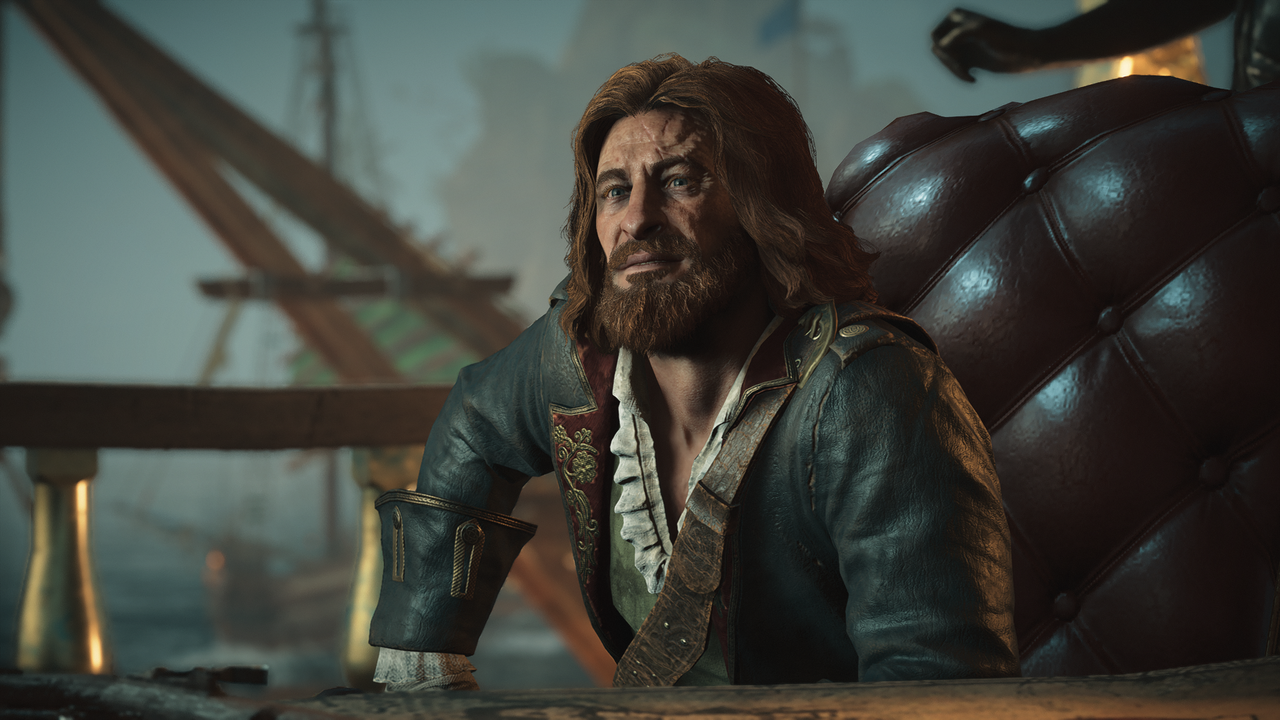
Of all Ubisoft’s follies, Skull and Bones feels like one of the most significant—a game that took the best parts of Assassin’s Creed 3 and Assassin’s Creed 4: Black Flag, and just stuck them in a dodgy live service treadmill.
It took a decade to make, seemed to be perpetually delayed, and just kept changing. It started out as a Black Flag expansion, then a Black Flag MMO spin-off, then something entirely unrelated to Assassin’s Creed. It was a huge mess, had no vision, and Ubisoft still charged $70 for it.
Ubisoft CEO Yves Guillemot defended the steep price by calling it a “quadruple-A game”. Nobody believed him.
The whole saga seemed ridiculous. At no point were we shown anything to justify Guillemot’s confidence, and sure enough, the game failed to make a splash. Now imagine how weird it would have been to watch this all unfold if you’d designed the bones it was built on.
Before leaving Ubisoft to co-found the studios behind Journey to the Savage Planet (Typhoon) and Revenge of the Savage Planet (Raccoon Logic), Alex Hutchinson was the creative director on Far Cry 4 and Assassin’s Creed 3, the first Assassin’s Creed to give us the naval battles, which would eventually lead to the brilliant Black Flag.
It was “bizarre”, he tells us, “to see essentially the same stuff re-shipping 14 years after we made it”. Assassin’s Creed 3’s sailing was an experiment that Ubisoft didn’t have a lot of faith in, but it proved to be the game’s greatest feature, resulting in it being given top billing in both Black Flag and Rogue. But it was old news by the time Skull and Bones finally launched.
“Ideas have a window, and that’s another reason we’re trying to do things faster this time,” he says. “They age out and become stale. I think the team was junior. They were trying to essentially make Black Flag crossed with World of Tanks or World of Warships. But I don’t think they had experience in that. And then they didn’t really have experience in making even an Assassin’s Creed game down there, because they really did co-development. And then I think it just got away from them.”
Ubisoft Singapore was established in 2008 and, by the time it was working on Skull and Bones, had ballooned to more than 300 employees. Prior to that, it mostly served as a support studio, and assisted in the development of every Assassin’s Creed from AC2 onward.
While Ubisoft would sometimes send devs from the Canadian and French studios to help Ubisoft Singapore, Hutchinson describes these excursions as holidays.
“For a lot of the French or Canadian developers, they would go down to Singapore for a year’s holiday,” he says. “They weren’t going down there to make that studio huge. They were like, ‘Oh, that’d be fun to work for a year in Singapore.’ I don’t think they were serious. And you couldn’t get as many people, the talent pool just wasn’t deep enough.”
When Skull and Bones finally launched, it found itself jockeying for position with countless other live service games, many of which were free to play. What may have seemed novel and full of potential in 2013 had become rote. The only surprise is that Ubisoft is still maintaining it, but I suspect it will end up in Davy Jones’s locker before too long.