


On December 6, 2025, a powerful magnitude 7.0 earthquake struck the remote St. Elias Mountains, a highly glaciated range that spans the Yukon-Alaska border. The quake shook the landscape beneath Hubbard Glacier, sending ice and rock careening down the range’s steep slopes. The NISAR (NASA-ISRO Synthetic Aperture Radar) satellite offered some of the earliest views of the changed landscape.
Geophysicist Eric Fielding and colleagues at NASA’s Jet Propulsion Laboratory (JPL) typically use satellite data to map the displacement of the ground after major earthquakes strike land. But in this region, such maps—known as interferograms—are not possible because the ground lies buried beneath a layer of glacial ice that’s at least 700 meters (2,000 feet) thick. “The cryosphere is covering up the geosphere,” Fielding said.
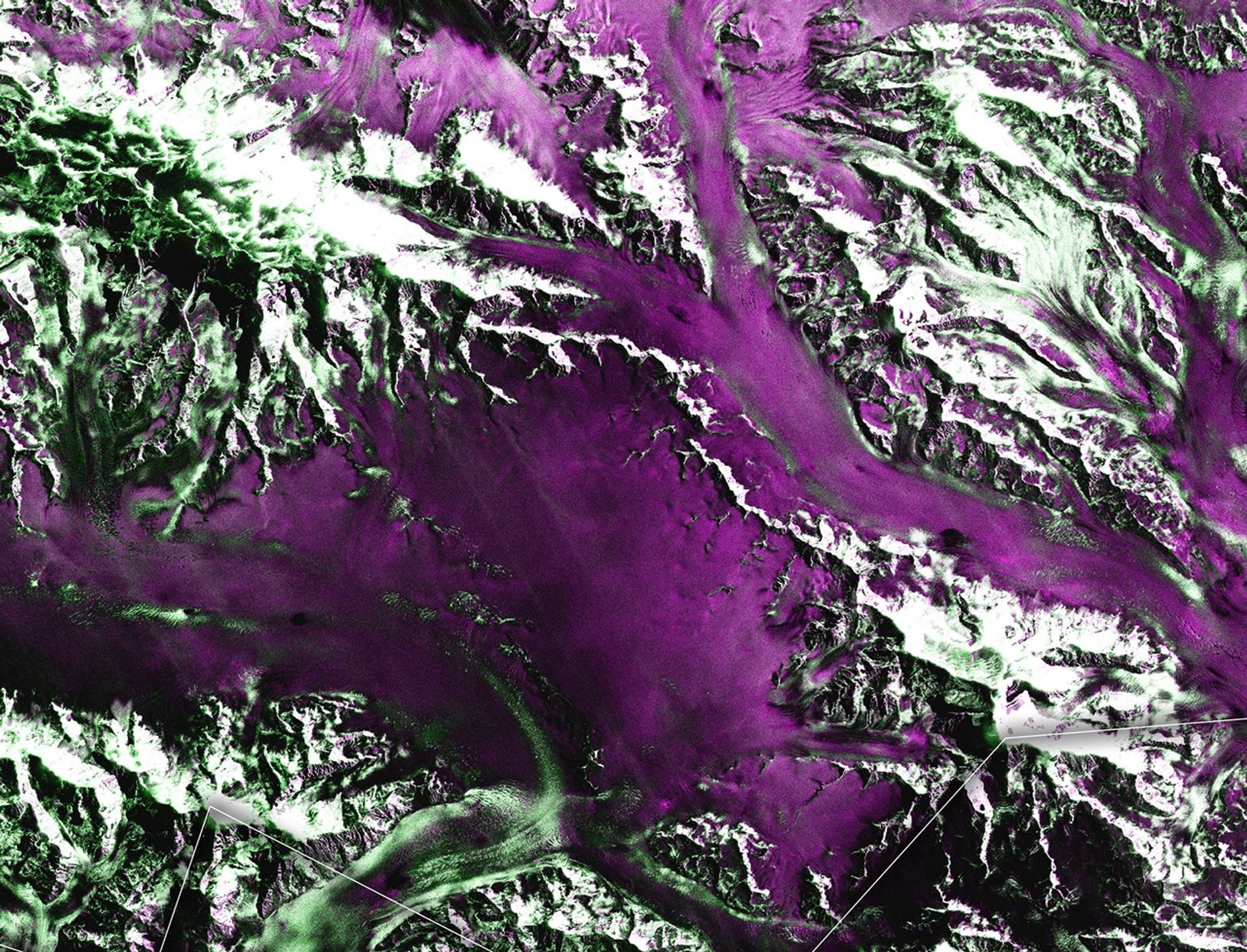
Instead, clues to the earthquake’s destructive power lay strewn atop the ice surface. The shaking on December 6 unleashed landslides and avalanches that swept debris onto lower, flatter stretches of the glacier. The debris is visible in radar imagery acquired by NISAR on December 8, two days after the quake (right). For comparison, the NISAR image on the left shows the same area on November 26, a week and a half before the quake.
Where the slides have deposited rock, snow, and other debris, surfaces have become rougher, which scatters more energy back toward the sensor and makes those areas appear bright in the December 8 image (the roughest areas are shown in dark green). Areas with smooth surfaces reflect little of the radar’s energy directly back to the satellite sensor, so these parts of the images appear dark (shown in purple). Note that there are some exceptionally rough, green surfaces beyond the new slide areas that remain relatively unchanged between the two images.
The largest slide in the scene appears to be cascading down the flank of Mount King George, but it’s far from the only one. Numerous others scar the surrounding terrain, including areas to the west along the slopes of Mount Logan, Canada’s tallest mountain.
Alex Gardner, a glaciologist at JPL and member of the NISAR science team, reviewed the images with Fielding. “The sheer number and magnitude of avalanches and landslides is astounding,” Gardner said. “I’ve personally never seen anything like this before.”
A separate preliminary analysis by the U.S. Geological Survey identified more than 700 potential landslides and snow avalanches, with an especially high concentration northwest of the epicenter along the fault rupture. Follow-up flights by the Yukon Geological Survey on December 12 provided a closer look, showing some slopes remained actively unstable, with dust still hanging in the air, and widespread damage to glacial ice.
Much of the debris that settled atop the region’s glacial ice is likely being transported toward the ocean by the glaciers’ ongoing seaward flow, which acts as a natural “conveyor belt.” For example, a tributary glacier of Hubbard north of Mount King George, which had previously moved at a sluggish pace, entered a surging phase in November before the earthquake. It is now moving downslope at what Gardner described as “breakneck speeds” of up to 6,000 meters per year (about 50 feet per day).
Although the region is uninhabited, the slides and damaged ice could pose new hazards for mountaineers and other expeditions, USGS noted in a December 18 update. The town of Yakutat, Alaska, about 90 kilometers (56 miles) south of the epicenter, is a common staging point for people exploring the area.
NISAR observations are expected to provide imagery to support future natural disaster response efforts.
Images by Gustavo Shiroma (JPL) of the NISAR Algorithm Development Team using data from the NISAR GSLC product, and prepared for NASA Earth Observatory by Lauren Dauphin. Story by Kathryn Hansen.

- Das, G., et al. (2025) Mapping Glacierized Regions With Quad-Pol Dual Frequency LS-ASAR: Insights for the NISAR Mission. IEEE Journal of Selected Topics in Applied Earth Observations and Remote Sensing, 18, 26338-26354.
- Martinez, S. N., et al. (2021) Evaluation of Remote Mapping Techniques for Earthquake-Triggered Landslide Inventories in an Urban Subarctic Environment: A Case Study of the 2018 Anchorage, Alaska Earthquake. Frontiers in Earth Science, 9, 673137.
- NASA (2025, July 30) NASA-ISRO Satellite Lifts Off to Track Earth’s Changing Surfaces. Accessed February 23, 2026.
- U.S. Geological Survey (2025, December 10) 2025 M7.0 Hubbard Glacier Earthquake-Triggered Landslides and Snow Avalanches. Accessed February 23, 2026.
- U.S. Geological Survey (2025, December 6) M 7.0 – 2025 Hubbard Glacier Earthquake. Accessed February 23, 2026.

