


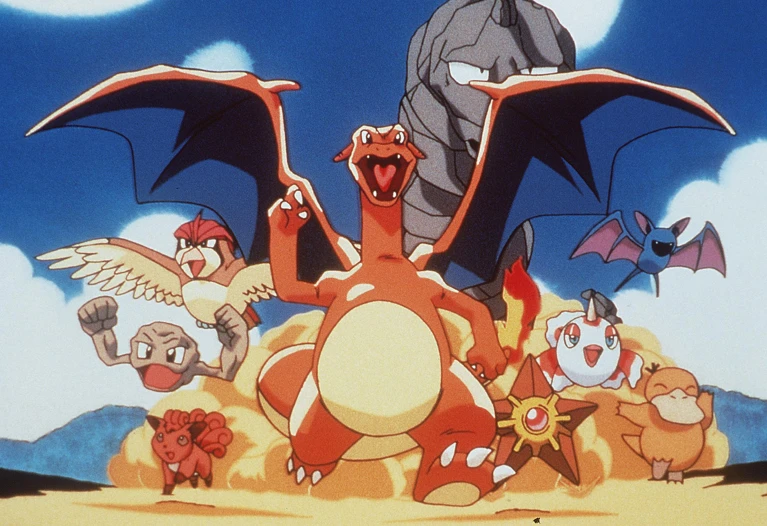
Pokémon has been an inspiration for researchers since its creation 30 years ago.Credit: Hulton Archive/Getty
On 27 February 1996, Japanese game designer Satoshi Tajiri released the first ever Pokémon games for the Nintendo Game Boy. What started as a childhood passion for collecting insects grew into a giant franchise and global phenomenon with themes of science at its heart.
The fictional world of Pokémon has found its way into science and academic research, including ecology, fossils, evolution, biodiversity, education and even calling out predatory journals.
“It influenced my idea of what animals and natural history were, almost before I knew what real animals in the real world were like,” says Arjan Mann, assistant curator of fossil fishes and early tetrapods at the Field Museum in Chicago, Illinois, who was a child when the television series came out.
For Pokémon’s 30th anniversary, Nature spoke to scientists from around the world about how their work has been shaped by playing Pokémon games, watching animated TV series and films and trading cards in school playgrounds.
Gotta catch ’em all
For some researchers, themes in the Pokémon games mirror their everyday work. Spencer Monckton, a research scientist at the University of Guelph in Canada, who grew up playing the games and watching the TV series, says that collecting Pokémon is “very much the same thing as what an entomologist does. They’re trying to catch them all.”
The players also learn how to categorize the diverse fictional creatures according to their features and abilities. “That’s just classification. That is exactly what a taxonomist does,” adds Monckton.
Boss level: how developing a video game during my PhD honed my leadership and time-management skills
In 2013, while pursuing his master’s degree, Monckton spent several months driving around Chile collecting bees. After analysing the shape and DNA of bees from the Heteroediscelis subgenus of Chilicola, he identified eight new species1. One of these species had an elongated face that was “drawn out like the snout of a horse or a dragon”, says Monckton, who later named this species Chilicola charizard, after the draconic Pokémon with fiery breath.
Fossils are another major theme in Pokémon, and from 22 May, visitors to the Field Museum in Chicago, Illinois, can visit an exhibition featuring Pokémon and the real-life fossils they are based on. Currently, there are 1,025 Pokémon in the franchise’s Pokédex, up from 151 in the original games. Dozens of Pokémon are named after real-life animals, and some real-life species are also named after Pokémon characters.
These include Aerodactyl which is based on the flying reptiles known as pterosaurs, such as Pterodactylus or Aerodactylus — the latter genus was named after the Pokémon character in 2014. Pterosaurs are “prehistoric flying animals that are distantly related to dinosaurs, but are not dinosaurs”, explains Mann, who is the scientific lead on the exhibition. Other examples shown at the exhibition include the Pokémon Archeops, inspired by Archaeopteryx, a 150-million-year-old feathered dinosaur long considered the earliest known bird.

The fossilized remains of an Archaeopteryx, a 150-million-year-old feathered dinosaur that inspired the Pokémon Archeops.Credit: Chris Hellier/Science Photo Library
Learning tools
Pokémon has also helped researchers to develop resources for teaching. A 2002 survey of 109 schoolchildren in the United Kingdom aged 4–11 years old reported that children could name significantly more Pokémon characters than they could local wildlife species2. In 2010, researchers appalled by the findings designed a Pokémon-inspired card-trading game, which they named Phylo. Players build food chains, create stable ecosystems and sabotage opponents’ ecosystems, racking up points in the process. They also learn about how climate change and oil spills can destroy these ecosystems, says Meggie Callahan a specialist in human–wildlife relationships at the University of Washington in Seattle who has studied how use of the game can aid conservation efforts.
The life aquatic: this board game lets you dip into marine ecology

